Annual Meeting 2008: The Human Face of Climate Change

24-25 June 2008 Hotel Intercontinental Geneva
7- 9 Chemin du Petit Saconnex
Geneva, Switzerland
Programme Day two
Wednesday, 25 June
Parallel Roundtables
08:30 - 10:15
Energy for the Poor: Energizing the MDGs
Often referred to as “the missing MDG”, energy is pivotal to achieving all of the Millennium
Development Goals. Its production and consumption are also a key factor in protecting
against the adverse impacts of climate change. At the same time, improving the standard
of living of the world’s poor must be grounded in sustainable development; it must favour
latest clean technologies over the fossil fuel-based sources privileged by the majority of
the world’s modern economies. What incentives are needed to substantially boost
investment in energy services for the poor? What feasible opportunities exist for
decentralized, “leapfrog”, resilient and renewable energy technologies?
John Drexhage, Director of Climate Change and Energy, the International Institute for
Sustainable Development
Jan van der Eijk, Group Chief Technology Officer, Royal Dutch Shell
Donald Kaberuka, President, African Development Bank
Susan McDade, UNDP Resident Representative, Cuba
Moderated by
Rajendra Pachauri, Chairman, Intergovernmental Panel on Climate Change (IPCC);
Chairman, The Energy and Resources Institute (TERI)
08:30 - 10:15
Climate Responsibility and Global Media
As the outreach and influence of global media continues to expand, what role can be
played in building global climate responsibility? What can the information media industry
do to illustrate the magnitude of the climate problem? How can climate justice be
communicated by the media? And how can latest technologies be used to bridge the
communication gap that separates rich from poor?
Mo Ibrahim, founder, Celtel International; founder,
the Mo Ibrahim Foundation
Ahmed Sheikh, Head of News, Al Jazeera Arabic
David Shukman, Environment and Science correspondent, BBC News
Carl-Henric Svanberg, Chairman of the Board, Sony Ericsson Mobile Communications;
President and CEO, Ericsson
Moderated by
Barbara Stocking, Director, Oxfam GB
08:30 - 10:15
Climate Change and Health: What Partnerships?
The enormous impact climate change is having and will have on public health is only
beginning to be seen as cause for serious concern. Heat, malnutrition and hunger facilitate
the spread of vector borne diseases like malaria, schistosomiasis and dengue fever.
Flooding can dramatically increase the likelihood of contracting water borne diseases,
such as cryptosporidiosis, amoebiasis or typhoid, as clean water is often unobtainable or
becomes contaminated. While little or no access to medical services and medication
mean diseases go untreated and epidemics unrestrained. Drugs, the Internet, and other
latest technologies are needed to combat these growing health concerns, but are rarely at
the disposal of those most in need. What partnerships can change that?
Bernard Kouchner, Foreign Minister, France;
founder, Médecins sans Frontières (t.b.c.)
Klaus Leisinger, President and CEO, Novartis Foundation for Sustainable Development;
Special Advisor of the UN Secretary-General on the Global Compact
Eric Rasmussen, CEO, InSTEDD (t.b.c.)
Moderated by
David Nabarro, UN System Senior Coordinator for Avian and Human Influenza
08:30 - 10:15
Dealing with Regional Water Stress
In the past, availability of water resources have dictated human settlement. Climate
change is shifting the availability of water worldwide, with pressurizing consequences on
communities in a number of regions. Water stress in the form of severe drought, dwindling
groundwater sources and changing rain patterns is rendering land uninhabitable in worst
affected areas. Is mass migration the only sensible long-term solution for such situations?
In more marginal contexts, can traditional settlements be safeguarded by more effective
resource management practices, such as crop substitution or advanced irrigation? Could
net import of water-intensive goods be another promising strategy?
Louise Arbour, UN High Commissioner for Human Rights
E. Neville Isdell, Chairman, The Coca Cola Company
Brunson McKinley, Director General, International
Organization for Migration
Youba Sokona, Executive Secretary, Sahara and Sahel Observatory
Moderated by
Jeffrey Sachs, Director, The Earth Institute at Columbia University; Special Advisor to the
UN Secretary-General on the Millennium Development Goals
08:30 - 10:15
Practical Solutions to Empower Vulnerable People and Communities
Basic solutions, such as drip irrigation and roof-water harvesting, can significantly boost
the resilience of communities against climate threats. Information and communication
technologies can empower vulnerable communities by increasing access to crucial
knowledge. They can also help create a sense of global responsibility and citizenship by
connecting people from any region of the world. What are the most promising solutions?
How can their implementation be accelerated? And at the local level, what means do
communities have to manage their adaptation needs?
Madeleen Helmer, Head, Red Cross/Red Crescent
Climate Centre
Dean Hirsch, President and CEO, World Vision International
Samuel Kobia, General Secretary, World Council of Churches
Julia Marton-Lefevre, Director General, World Conservation Union (IUCN)
Judith Rodin, President, Rockefeller Foundation
Moderated by
Rinalia Abdul Rahim, Executive Director, Global Knowledge Partnership
08:30 - 10:15
Coastal Cities in the Global South: Waiting for the Next Mega-Disaster?
Coastal cities constitute the backbone of international trade and the world economy.
Assets of these cities that are exposed to climate risks are estimated to reach 9% of
global GDP by 2070. Expensive measures in urban administration, planning and civil
defence will help some cities to manage these risks. For many developing country cities,
however, adaptation is often a politically unjustifiable luxury. Yet a Cyclone Nargis could be
repeated in any number of least developed zones. Are we simply waiting for the next
mega-disaster? Or can we ensure climate-proofing for even the poorest of the world’s
vulnerable coastal cities?
Celine Herweijer, Principal Scientist of Future Climate, Risk Management Solutions
Adam Kimbisa, Mayor, Dar es Salaam
Markku Niskala, Secretary-General, the International Federation of Red Cross and Red
Crescent Societies
Moderated by
Goh Kee Nguan, Brigadier General, Singapore Armed Forces
10:15 - 10:30
Break
Plenary
10:30 - 12:00
Open Debate on the Conclusions of the Roundtables
12:00 - 12:45
Keynote/Debate
12:45 - 13:00
Closing Remarks
Kofi A. Annan, President, Global Humanitarian Forum;
UN Secretary-General (1997-2006)
13:00 - 14:00
Luncheon
14:00 - 15:00
A Road Map for New Ideas on Adaptation to Climate Change:
the BrainStore Approach
Markus Mettler, Chairman, co-founder & IdeaDirector, BrainStore
16:00 - 16:30
Press Conference
Tuesday, 24 June
Source:
www.ghf-geneva.org/ (18 June 2008).
|
 ecostory
  40/2008
 next
next
 Programm 24-25 June
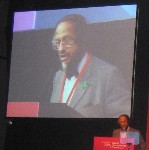 This is Dr Rajendra Pachauri telling the world that 1.6 billion people do not have electricity and that providing access to electricity would initially increase climate gas emissions.
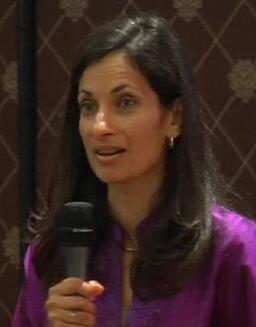 Nisha Pillai said she had been parashuted into this debate - she and the media depended on clear and understandable language.

 to
to  halt
halt  | ecostory | feedback