Annual Meeting 2008: The Human Face of Climate Change

24-25 June 2008 Hotel Intercontinental Geneva
7- 9 Chemin du Petit Saconnex
Geneva, Switzerland
Programme
This is the latest programme of the Annual Meeting 2008. Further
updates will be accessible through the Forum’s website:
www.ghf-ge.org. A final programme will be sent out shortly prior
to the conference.
Tuesday, 24 June
Plenary [questions]
09:15 - 09:30
Welcome - Representative of the Swiss Federal Government
Laurent Moutinot, President of the State Council, Republic and Canton of Geneva
09:30 - 09:45
Opening Address: The Human Face of Climate Change
Kofi A. Annan, President, Global Humanitarian Forum;
United Nations Secretary-General (1997-2006)
09:45 - 10:15
Climate Witnesses:
Young people from vulnerable communities in affected regions speak out on how climate
change affects their lives - in cooperation with the British Council, including:
James Bing (Marshall Islands)
Jesse Mike (Nunavut,Canada)
Mama N'doda (Togo)
Guilherme Pastore (Brazil)
Rishika Das Roy (India)
Moderated by
Martin Davidson, CEO, British Council
10:15 - 10:45
Break
10:45 - 12:30
Climate Justice in a Shared Global Ecosphere
The wealth of the industrialized world is largely based on past and current fossil fuel
consumption that is itself the principle cause of global warming. Those who have
consumed the least carbon resources, who have contributed the least to climate change,
suffer the brunt of its adverse effects. Under a shared ecosphere, and given scarce global
resources, historical economic growth has also seriously exacerbated ongoing poverty
reduction efforts. But linking these issues together can be grounds for a global solution.
Could the architecture of a post-Kyoto agreement be capable of effectively reconciling
these injustices? Or is a post- Kyoto framework destined to be an effective tool only for the
promotion of emission reductions? Would emission trading on a worldwide but individual,
per capita, level provide a better instrument for ensuring global climate justice? Indeed,
could personal responsibility for individual carbon emissions provide for a new system of
global equity? Do other serious alternatives exist?
Yvo de Boer, Executive Secretary, UN Framework Convention on Climate Change
(UNFCCC)
Richard Branson, Chairman, Virgin Group
Maumoon Abdul Gayoom, President of the Maldives
Ricardo Lagos, Special Envoy of the UN Secretary-General on Climate Change;
President, Club of Madrid; President of Chile (2001-2006)
Moderated by
Mary Robinson, President, Realizing Rights; UN High Commissioner for Human Rights
(1997-2002); President of Ireland (1990-1997)
12:30 - 14:00
Luncheon
Parallel Roundtables
14:00 - 16:00
The Climate-Security Nexus: Conflict or Cooperation?
Climate change will place vulnerable communities under unbearable stress. Impacts such
as more frequent and intense storms and flooding are causing new and more acute
humanitarian crises. In some regions, slower-onset disasters, such as climate change
driven water stress are exacerbating existing humanitarian situations, and may already be
fuelling regional instability in worst affected areas. In the Sahel, we witness tensions
among competing nomads, subsistence farmers and other communities, while the retreat
of glacial ice in the arctic zone may be cause for confrontation in the scramble for new
resources. Can we talk of “resource wars”? What is the extent of the link between climate
and security now and tomorrow? Over the coming half-century, could climate change
redefine security policy worldwide? How can we encourage better cooperation among
peoples and nations to meet these challenges and avoid the great potential for conflict,
particularly among competing vulnerable communities?
Mats Berdal, Professor of Security and Development, Department of War Studies, King’s
College, London
Gareth Evans, President and CEO, International Crisis Group; Foreign Minister, Australia
(1988-1996)
Rita Hauser, President, The Hauser Foundation; Chair, Board of Directors, International
Peace Institute
Jakob Kellenberger, President, International Committee of the Red Cross
Alois Hirschmugl, Brigadier General, International Operations Command, Austrian
Armed Forces
Javier Solana, High Representative for the Common Foreign and Security Policy,
European Union; Secretary-General, Council of the European Union; Secretary-General,
Western European Union; Secretary-General, NATO (1995-1999)
Moderated by
Jan Egeland, Director, Norwegian Institute of International Affairs;
Special Adviser to the UN Secretary-General on matters relating to the prevention and
resolution of conflict; Under-Secretary-General for Humanitarian Affairs and Emergency
Relief Coordinator (2003-2006)
14:00 - 16:00
5 Key Priorities for Food Security in a Changing Climate
Drought, changing rainfall patterns, insect infestations and other climate change impacts
are dramatically aggravating food scarcity in a number of already vulnerable zones.
Meanwhile, demand for bio-fuel materials and unfavourable international trade regimes
among other factors are causing food prices to reach historic heights. This development is
having serious consequences for a number of vulnerable groups, notably the urban poor.
At the same time, however, high food prices coupled with continued population expansion
are creating new opportunities for farming in poor regions. What are 5 strategies that
could enable farmers to take advantage of these opportunities and strengthen food
security in the face of worsening climate risks?
Jill Lester, President and CEO, The Hunger Project
John Holmes, UN Under-Secretary-General for Humanitarian Affairs and Emergency
Relief Coordinator; Coordinator, UN High Level Task Force on the Global Food Crisis
Michel Jarraud, Secretary-General, World Meteorological Organization
Pascal Lamy, Director-General, World Trade Organization (t.b.c.)
Olivier De Schutter, UN Special Rapporteur on the Right to Food
Manuel Aranda da Silva, Senior Adviser to the Executive Director, World Food
Programme; Deputy Special Representative of the UN Secretary-General and
Humanitarian Coordinator, UN Mission in Sudan (2004-2007)
Moderated by
Catherine Bertini, Professor of Public Administration, Maxwell School of Citizenship and
Public Affairs, Syracuse University; Executive Director, World Food Program (1992-2002)
14:00 - 16:00 Are the Right Risks Insured?
Given the scale and breadth of the climate threat, do current patterns of insurance
accurately reflect exposure to this new risk on global and regional levels? To what extent
are climate-related risks themselves “insurable”? Many developing countries lack any
insurance coverage for climate risks whatsoever, even in worst affected regions. As
climate change impacts intensify, this insurance deficit will not only impede recovery from
large-scale disasters, but also further deter investment where often unfavourable business
conditions already prevail. What policies are needed to overturn the climate-insurance
deficit for worst affected and most vulnerable regions? Would the appointment of chief risk
officers close to political decision-makers be a positive first step?
Jacques Aigrain, CEO, Swiss Re
Gunilla Carlsson, Minister for International Development Cooperation, Sweden;
Chairperson, Commission on Climate Change and Development
Mary Chinery-Hesse, Chief Advisor to the President of Ghana
Kemal Dervi?, Administrator, UN Development Programme (UNDP)
Jay Ralph, CEO, Allianz Reinsurance
Simon Upton, Chair, OECD Round Table on Sustainable Development
Moderated by
Donald Johnston, Chairman, International Risk Governance Council; Secretary-General,
OECD (1996-2006)
14:00 - 16:00
Design and Urban Planning: New Forms of Urban Life - New Forms
of Development?
For most of human history, design followed the respective availability of natural raw
materials. With industrialization and globalization, human activity and settlements have
become unsustainable, and increasingly so. Our planet cannot bear further greenhouse
gas intensive economic growth. If all developing countries are to achieve a high standard
of living, the traditional carbon-reliant model cannot be followed. There is a need for new,
substantially greener practices. What contribution can smart design and urban planning
make towards sustainable development and adaptation for most vulnerable communities?
Could good design also help to better harness the resources and traditional knowledge
available to developing countries? What could local design and urban planning look like in
the twenty-first century? What type of lifestyles and infrastructure are most desirable? Do
we need new models of development?
Michelle Colley, Risk Manager, Acclimatise
John Raftery, Dean, School of the Built Environment, Oxford Brookes University
Darren Robinson, Group Leader, Sustainable Urban Development, Ecole Polytechnique
F´dérale de Lausanne
Malcolm Smith, Director, Integrated Urbanism, Arup Consulting
Amy Smith, Senior Lecturer, Departement of Mechanical Engineering, co-founder,
International Development Initiative, and founder, Designs for Developing Countries
Project, Massachusetts Institute of Technology (MIT)
Anna Tibaijuka, Executive Director, United Nations Human Settlements Programme
(UN-HABITAT)
Moderated by
George Scharffenberger, Executive Director, Richard C. Blum Centre for Developing
Economies, University of California, Berkeley
14:00 - 16:00
What are Business Opportunities for Adaptation?
Adaptation to climate change for most vulnerable communities is estimated to cost in the
realm of US$50 billion per year. How much of this figure represents business
opportunities? What are the main business opportunities for adaptation? At the same
time, adaptation is such a large-scale endeavor that it must be driven by a range of
stakeholders, including governments, the private sector, civil society and other partners.
However, the private sector continues to be under-engaged compared to other sectors,
particularly with respect to most vulnerable groups. What scope is there for triggering
more private sector involvement through government incentives? And what would be the
appropriate incentives and/or regulatory frameworks?
Ela Bhatt, founder, India's Self-Employed Women's Association
Frits van Dijk, Executive Vice President and Zone Director for Asia, Oceania, Africa and
Middle East, Nestl´
Bert Koenders, Minister for Development Cooperation, Netherlands
Iqbal Quadir, Executive Director, Legatum Centre for Development and
Entrepreneurship, Massachusetts Institute of Technology (MIT)
Eric Rey, President and CEO, Arcadia Biosciences
Roland Stulz, Executive Director, Novatlantis,
Swiss Federal Institute of Technology Domain
Moderated by
Michel Camdessus, Member, Commission for Africa; Managing Director, International
Monetary Fund (1987-2000); Governor, Bank of France (1984-1987)
14:00 - 16:00
Innovative Financing for Adaptation: What New Ideas?
Climate change impacts may derail attainment of the Millennium Development Goals by
2015, and in some cases, may even undo existing development investments. Adaptation
is the safeguard to this, but will require substantial additional finance above current levels
of Official Development Assistance (ODA), which itself continues to fall short of the 0.7%
target. In addition, given that climate change is impacting on people and communities
now, adaptation is an urgent need. How can funds be more rapidly mobilized? Should
adaptation spending be made eligible for ODA labelling for the immediate future? Is
another alternative the launch of a new “global fund” to gather and coordinate financing on
adaptation for those worst affected? Or will we have to wait for a global post-Kyoto
agreement in order to effectively finance such needs?
Rajat Gupta, Chair of the Board, the Global Fund to fight AIDS, Tuberculosis and Malaria;
Senior Partner Worldwide Emeritus, McKinsey&Company
Caio Koch-Weser, Vice-Chairman, Deutsche Bank
Ivan Pictet, Vice-President, Global Humanitarian Forum; Senior Managing Partner,
Pictet & Cie
Jean-Louis Schiltz, Minister of Development Cooperation and Humanitarian Affairs,
Communications and Defence, Luxembourg
Heidemarie Wieczorek-Zeul, Federal Minister for Economic Cooperation and
Development, Germany
Moderated by
James Wolfensohn, founder, the Wolfensohn Centre at the Brookings Institute,
Washington DC; President of the World Bank Group (1995-2005)
Plenary
16:30 - 18:00
Open Debate on the Conclusions of the Roundtables
19:30 - 21:30
Boat Cruise/Dinner
Dinner boat cruise on Lake Leman
Wednesday, 25 June
Source:
www.ghf-geneva.org/ (18 June 2008).
|
 ecostory
  40/2008
 next
next
 Programm 24-25 June
Wednesday, 25 June
Programm 24-25 June
Wednesday, 25 June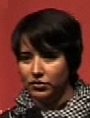 This is Jesse Mike, a young climate change witness from the Nunavut, Canada, telling of the death of her friend because of thin ice that shouldn't have been thin.
  to
to  halt
halt  | ecostory | feedback