Summary of conclusions - UNEP press info 21 February 2011 
Embargoed until 21 February, 10am GMT
Towards a Green Economy: Pathways to Sustainable Development and
Poverty Eradication - A Synthesis for Policy Makers
A Summary of the Conclusions
Investing just 2% of global GDP into ten key sectors can kick-start a transition towards a
low-carbon, resource-efficient economy. The new UNEP report demonstrates that a transition
to a green economy is possible by investing 2% of global GDP per year (currently about US 1.3
trillion) between now and 2050 in a green transformation of key sectors, including agriculture,
buildings, energy, fisheries, forests, manufacturing, tourism, transport, water and waste
management. However, such investments must be spurred by national and international policy
reforms.
Conducted by global experts and institutions from both developed and developing countries, this
timely report confirms that under a green economy scenario economic growth and environmental
sustainability are not incompatible. On the contrary, a green economy creates jobs and economic
progress, while at the same time avoiding considerable downside risks such as the effects of
climate change, greater water scarcity and the loss of ecosystem services.
Greening the economy not only generates growth, and in particular gains in natural capital,
but it also produces a higher growth in GDP and GDP per capita. Under the GER modeling
exercise, a green investment scenario achieves higher annual growth rates than a business as
usual scenario within 5-10 years. This economic growth is characterized by a significant
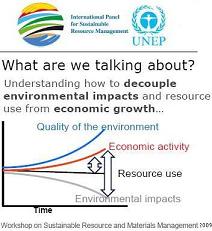
decoupling from environmental impacts with the global ecological footprint to biocapacity ratio
projected to decline from a current level of 1.5 to less than 1.2 by 2050 – much closer to a
sustainable threshold value of 1 – as opposed to rising beyond a level of 2 under business as usual.
Global demand for energy rises somewhat but returns to current levels by 2050, which is about
40% less than what is expected under business as usual thanks to substantial advances in energy
efficiency. A green investment scenario is projected to reduce energy-related CO2 emissions by
about one-third by 2050 compared to current levels. The atmospheric concentration of emissions
should be held below 450 ppm by 2050, a level essential for having a chance to limit global
warming to the 2°C threshold.
A green economy values and invests in natural capital. One-quarter of the green investments
analyzed – 0.5% of GDP (US $325 billion) – is allocated to natural capital sectors: forestry,
agriculture, freshwater and fisheries. Value added in the forest industry rises by about 20% in
2050 as compared to business as usual. Investments in green agriculture ranging from US $100-
300 billion per year over 2010-2050 would lead over time to rising soil quality and increasing
global yields for major crops, representing an improvement of 10% above what is possible with
current investment strategies. Increased efficiency in agriculture, industrial and municipal sectors
would reduce demand for water by about a fifth by 2050, as compared to projected trends,
reducing pressure on groundwater and surface water in both the short and long term.
A green economy can contribute to poverty alleviation. There is an inextricable link between
poverty alleviation and the wise management of natural resources and ecosystems, due to the
benefit flows from natural capital that are received directly by the poor. It is particularly
important in low income countries, where ecosystem goods and services are a large component of
the livelihoods of poor rural communities and provide a safety-net against natural disasters and
economic shocks.
In a transition to a green economy, new jobs will be created, which over time exceed the
losses in “brown economy” jobs. This is particularly notable in the agriculture, buildings,
energy, forestry and transport sectors. However, in sectors whose capital is severely depleted,
such as in fisheries, greening will necessitate the loss of jobs and income in the short and medium
term in order to replenish natural stocks and prevent a permanent loss of income and jobs.
It may
also require an investment to re-skill and re-educate the workforce.
Prioritizing government investment and spending in areas that stimulate the greening of
economic sectors is on the critical path. Reforming costly and harmful subsidies in all sectors
will open fiscal space and free resources for a GE transition. Removing subsidies in energy, water,
fisheries and agriculture sectors, alone, would save 1-2% of global GDP a year. Fisheries
subsidies, for example, estimated at around US $27 billion a year, result in more damage than
long-term gains to national economies and social welfare. Price and production subsidies for
fossil fuels collectively exceeded US $650 billion in 2008, and this level of support discourages
the transition to renewable energies.
Using instruments, such as taxes, incentives and tradable permits to promote green investment
and innovation is also essential, but so is investing in capacity building, training and education.
Strengthening international governance and global mechanisms that support a transition are
important. The UN Conference on Sustainable Development (Rio+20 Summit) in 2012 will be
an opportunity to set a new direction for a more sustainable, secure and just world.
The scale of financing required for a green economy transition is substantial, but an order
of magnitude smaller than annual global investment. In this regard, it is worth noting that the
2% of global GDP modeled in the report is a fraction of total gross capital formation - about 22%
of global GDP in 2009). This amount can be mobilized by smart public policy and innovative
financing mechanisms. The rapid growth of capital markets, the market’s increasing interest in
green initiatives and the evolution of alternative instruments, such as carbon finance and
microfinance, are opening up the space for large-scale financing for a global economic
transformation. However, these amounts are still small compared to total volumes required, and
urgently need to be scaled up.
The move towards a green economy is happening on a scale and at a speed never seen
before. For 2010, new investment in clean energy was expected to reach a record high of US$
180-200 billion, up from US $162 billion in 2009 and US $173 billion in 2008. Growth is
increasingly driven by non-OECD countries, whose share of global investment in renewables rose
from 29% in 2007 to 40% in 2008, with Brazil, China, and India accounting for most of it.
It is expected to generate as much growth and employment – or more – compared to the
current business as usual scenario, and it outperforms economic projections in the medium
and long term, while yielding significantly more environmental and social benefits.
However, such a transition to a green economy will not be without its risks and challenges – from
“greening” traditional brown sectors to meeting rapidly changing market demands in a carbonconstrained
world. Therefore, world leaders, civil society and leading businesses must engage
collaboratively to rethink and redefine traditional measures of wealth, prosperity and well-being.
What is clear is that the biggest risk of all would be to continue with the status quo.
Also compare:
"Green Economy" - UNEP main page
www.unep.org/greeneconomy/Portals/88/documents/ger/GER_summary_en.pdf Synthesis Report
The Green Economy Report's leading authors:
"The synthesis report was led by Pavan Sukhdev, Special Adviser and Head, Green Economy Initiative, UNEP, and
coordinated by Steven Stone, Chief, Economics and Trade Branch, UNEP under the guidance of Sylvie Lemmet,
Director, Division of Technology, Industry and Economics, UNEP. Substantive contributions were received from
Anna Autio, Nicolas Bertrand, Derek Eaton, Fatma Ben Fadhl, Marenglen Gjonaj, Moustapha Kamal Gueye, Leigh-
Ann Hurt, Ana Lucía Iturriza, Cornis Van Der Lugt, Desta Mebratu, Robert McGowan, Asad Naqvi, Sheng Fulai,
Benjamin Simmons, Niclas Svenningsen and Vera Weick."
Renewable resources are products made of plant and animal material.
Renewables are regenerated by the interactive functioning of nature.
Sustainability is a state of human affairs where we don't consume more renewables than nature can regenerate.
Non-renewables are finite resource stocks, such as fossil fuels, uranium, metals and minerals, soil fertility, fossil water, a normal climate, space, natural forests, etc., that are not renewed by nature in a human time scale. Once they are depleted they are gone forever.
No technology or ingenuity or money can recreate lost minerals and biodiversity.
The UNEP "Green Economy Inititive" report and introductory documents are raising many serious questions and doubts. The report is embedded in the ideolog of Trade and Growth. It makes long term extrapolations without any reference to the problems of the Post-Peak-Oil era that is imminent. Population growth and scarcities can be met by - yet-to-be-developed - technologies, if we want to believe the UNEP economists.
We are asking the questions that expose a series of illusions
 back |
home |
population |
economics |
peak oil |
scenarios |
footprints back |
home |
population |
economics |
peak oil |
scenarios |
footprints

|

 Questions about the "Green Economy" and "Green Growth"
 The premises:



 "Sustainable Growth"
 ecoglobe since 1997